A home elevator is not a product you order and set in place.
It has to be planned around a specific location and coordinated with the home’s construction. Then it has to be installed, inspected, and maintained for decades. The company responsible for those steps matters as much as the equipment.
Many homeowners start by comparing national brands. Brand recognition feels reassuring. But the name on the elevator often doesn’t tell you who will install it, coordinate the project, or answer the service call ten years from now.
Before you choose an elevator, find out who will be responsible for it.
Two Ways to Buy a Home Elevator
Most residential elevator companies follow one of three models.
- Dealer for a National Manufacturer
Many established manufacturers sell through authorized dealers. The manufacturer builds the elevator. A local dealer sells, installs, and services it.
This model gives you proven product lines, standardized specifications, and manufacturer training behind the installation team. The quality of your experience depends on the dealer: their project management, installation standards, and technician coverage in your area.
- Full-Service Elevator Company
A full-service company manages every stage of the project. It plans the elevator, builds or supplies it, coordinates requirements with your builder, installs it, and maintains it.
Some full-service companies build custom elevators in their own factories. Many also carry established product lines from other manufacturers. Either way, one organization stays responsible for the outcome.
Comparing the Two Models
| What to Compare | Dealer for One Manufacturer | Full-Service Elevator Company |
|---|---|---|
| Starting price | Varies by product and dealer | Based on full project scope and customization |
| Installation | Authorized dealer | Company's own installation team |
| Project Coordination | Handled by the dealer | Handled by one organization |
| Product Range | Manufacturer's catalog | Custom-built systems plus established product lines |
| Permits and inspections | Usually handled locally | Handled by teams familiar with local requirements |
| Warranty | Shared between manufacturer and dealer | One company to call |
| Maintanance | Dealer or another authorized company | The company that installed it |
| Best Fit | Buyers who want a specific brand | Buyers who want custom design and one point of accountability |
Why One Point of Accountability Matters
A residential elevator project involves the elevator company, builder, architect, electrician, and other trades. Together they must resolve:
- Hoistway dimensions
- Pit and overhead clearances
- Door locations and landing configurations
- Structural support
- Electrical requirements
- Equipment access
- Cab dimensions and interior finishes
- Permits and inspections

A small discrepancy in any of these can delay installation or fail an inspection. When responsibility is split among unrelated companies, it takes longer to determine who has to fix the problem.
With one accountable company, you make one call.
That matters even more after installation, when the elevator needs service.
Local Knowledge Affects the Project
Residential elevators in the United States are governed by ASME A17.1, Section 5.3, the national safety standard for private residence elevators. Permit and inspection procedures, however, vary by state and local jurisdiction.
A company that works in your area regularly knows the documentation, scheduling, and inspection process. Its team can tell your builder what has to be complete before elevator installation begins.
That experience helps prevent:
- Incorrect hoistway dimensions
- Missing structural support
- Improper electrical preparation
- Door and gate conflicts
- Inspection delays
- Costly construction changes
Local knowledge does not replace good planning. It makes good planning easier to execute.
Custom Manufacturing Expands Your Design Options
National manufacturers offer proven cab styles, sizes, and finishes. For many homes, those standard packages work well.
Other projects need more design control.
A company with its own manufacturing can build the cab around your home’s interior. Materials, panel styles, fixtures, lighting, handrails, and gates can all be specified to match the architecture. This matters when the elevator is a visible design feature, not a utility space.
Factory-direct manufacturing also keeps lead times more predictable, because the company controls its own production schedule.

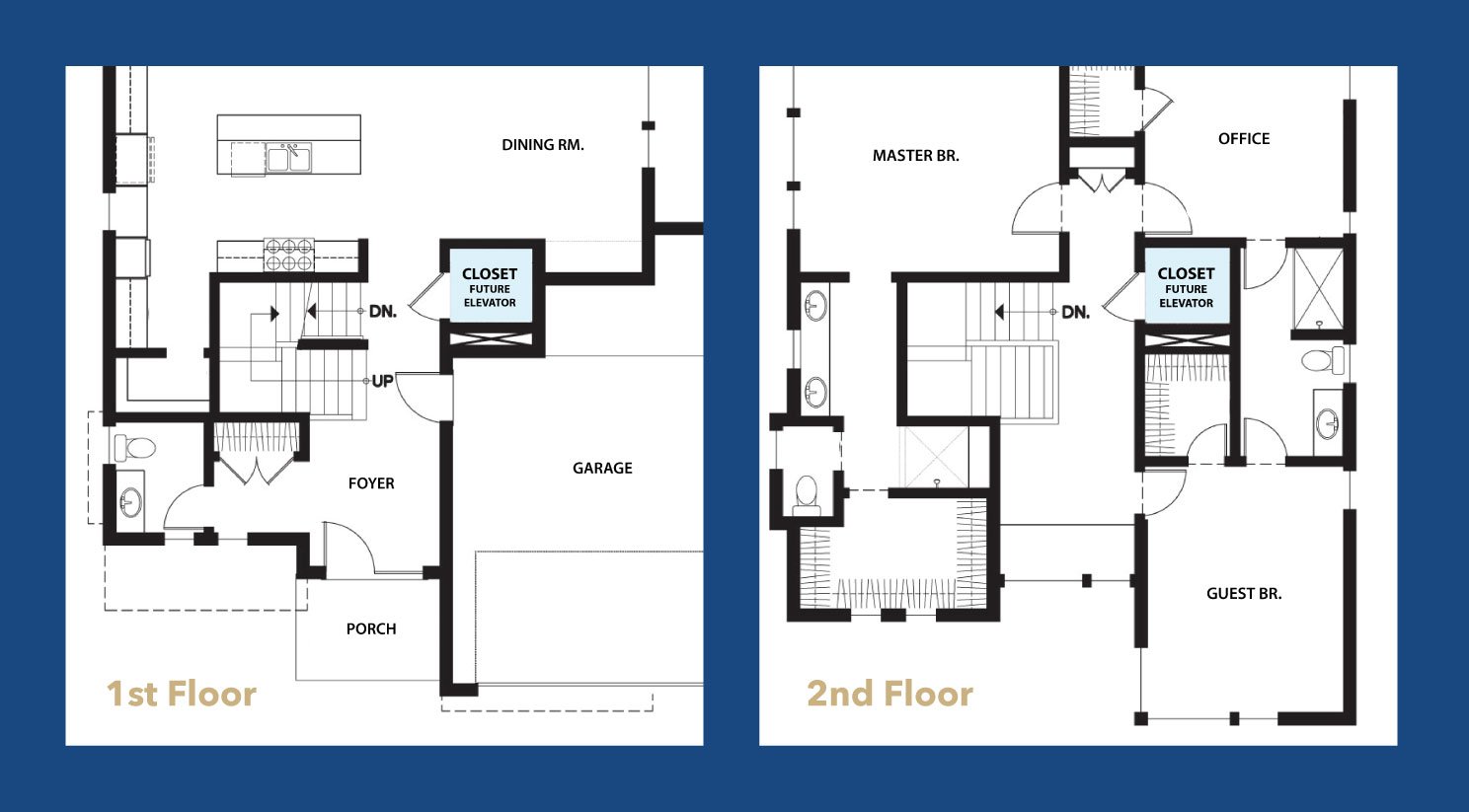
Final requirements depend on the elevator selected. Share plans with your elevator company before framing so dimensions are verified early.
For Builders and Architects: Plan Early
Elevator decisions made during design cost far less than changes made after framing.
Even if the buyer won’t install an elevator right away, you can build the home elevator-ready.
Typical requirements include:
- Stacked closets aligned vertically, approx. 25 sq. ft. per floor
- 12″ pit depth (8″ minimum)
- A rail wall free of plumbing and wiring, with solid block fill for concrete walls
- Two 2″ PVC conduits to the equipment area
220v 30-amp and 120v 15-amp power - Consistent finished-floor heights and door clearances
Consider the Elevator’s Lifetime Cost
A low equipment price does not always mean the lowest project cost.
Before comparing proposals, confirm whether each one includes:
- Design and planning assistance
- Project drawings
- Freight and delivery
- Installation
- Permitting and inspection coordination
- Cab finishes and fixtures
- Warranty labor
- Follow-up adjustments
- Preventive maintenance
- Emergency service
A lower quote can cost more once excluded work is added back in or divided among several contractors.
Residential elevators need routine maintenance. Over time, components need adjustment, repair, or replacement. The company you choose today may be your service provider for decades.

Is a Local Company Always the Better Choice?
No. A local address does not guarantee technical ability, financial stability, or dependable service.
Evaluate any elevator company carefully. Ask:
- Which elevator systems do you offer, and do you build or supply them directly?
- Who will install the equipment?
- Are your installers employees or subcontractors?
- Who handles permits and inspection coordination?
- What work must my builder or other contractors complete?
- Who provides warranty labor?
- Do you employ service technicians in my area?
- Do you stock commonly needed replacement parts?
- What maintenance programs do you offer?
- Will your company service this elevator if a dealer relationship changes?
The answers will tell you more than the logo on the brochure.
OUr Answers to Those Questions
Southeast Elevator is a regional company with local teams. Your project is handled by people based in your area, backed by our factory and more than 30 years of experience.
We have designed, built, installed, and serviced residential elevators for more than three decades. We build our custom residential elevators through factory-direct manufacturing, and we are an authorized dealer for PVE pneumatic vacuum elevators.
Our teams serve homeowners, builders, and architects across Florida, Texas, North Carolina, and South Carolina through our regional divisions:
- Gulfside Elevator, Southwest Florida
- Panhandle Elevators, Northwest Florida
- ZMA Lifts, Texas
- R.E.A.L. Elevator Solutions, North and South Carolina
Each division follows the same planning, installation, and service standards.
Installation: Completed by our own installation teams. [Confirm: employees in all divisions]
Permits and inspections: Coordinated by our regional teams. [Confirm: handled in every division]
Builder coordination: We review plans during design, verify dimensions on-site, and work with your superintendent and trades.
Warranty: 1-year limited warranty
Service: Our Premium Maintenance Plan includes 24/7 call support, a comprehensive maintenance and safety inspection, priority scheduling, two additional service calls, and 15% off parts.
* First year free on all new elevator installations.
Reputation: 4.9 Stars on 1,200+ Google reviews for Southeast Elevator and its divisions. (As of October, 2026)
Choose the Company, Not Just the Elevator
A recognized brand may offer quality equipment. A dealer may provide skilled installation. An equipment seller may offer an attractive starting price.
But a home elevator is a long-term system, not a one-time purchase.
Before you compare brand names, compare responsibility. Who will plan the system? Who will install it? Who will coordinate the inspection? Who will answer when it needs service years from now?
With Southeast Elevator, the answer to every question is the same team.

Plan Your Home Elevator With Southeast Elevator
Building a new home or adding an elevator to the one you have?
Talk with us early. We’ll evaluate the project, coordinate with your construction team, and help you choose the elevator that fits your home and your plans for living in it.
Southeast Elevator
811 Edwards Rd.
Fort Pierce, FL 34982
772-461-0030
seelevator.com